Illustrating Leadership Lesson: Presence
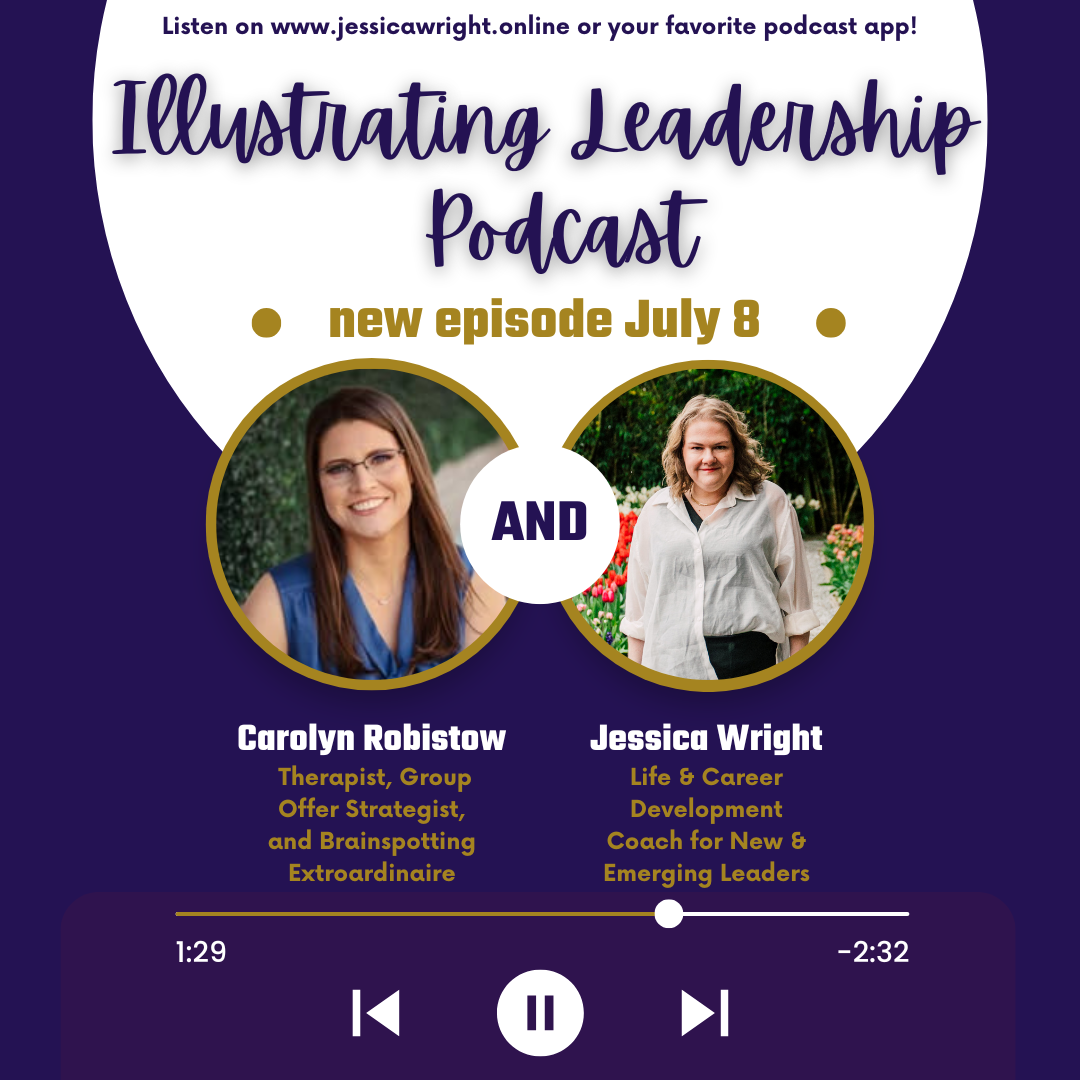
Today we're sitting down with Carolyn Robistow, a private practice therapist and group offer strategist, and someone who has become a very meaningful person in my life over the last year. Carolyn is thoughtful, funny, deeply insightful, and able to move from boat life to brain spotting to leadership wisdom in a way that feels both completely unexpected and exactly right.
What stayed with me most from this conversation was not one specific framework or strategy, although we certainly talked about those. What stayed with me was this:
Leadership is often less about having the perfect answer and more about being present enough to truly see the person in front of you.
Carolyn shared about the leaders who shaped her, especially her parents. Her father, who after a serious illness went on to start a business, modeled a kind of steady, quiet presence. It was only after his funeral that Carolyn fully realized how many people he had impacted simply by showing up. He visited people in the hospital. He encouraged her cross-country team from different points along the course. He noticed people. He was there.
Her mother modeled a different kind of leadership: activism, advocacy, and speaking up when something needed to be said. As a teenager, Carolyn admitted that this kind of leadership felt risky and embarrassing at times. Looking back, she could see the courage in it.
Two very different examples. One common thread.
Presence.
The kind of presence that says: I see you. I notice what is happening. I am willing to be here with you.
That is something I have heard over and over again across the seasons of Illustrating Leadership. Leadership is not confined to a title, a boardroom, a business, or a movement. Leadership shows up in the moment someone helps another person feel seen, supported, and part of something meaningful.
And yet, presence sounds simple until we actually need to practice it.
As leaders, parents, friends, partners, coaches, and humans, we often put pressure on ourselves to show up perfectly. We wonder if we will say the right thing. We worry about making it worse. We think we need the plan, the solution, the wise response, or the perfectly composed version of ourselves before we can enter the room.
But what if presence does not require perfection?
What if, sometimes, the most helpful thing we can say is:
“I am here. What would help you feel supported right now?”
That was one of the most powerful ideas Carolyn and I explored. Being present does not mean abandoning ourselves. It does not mean dropping everything, absorbing everyone else’s emotions, or making ourselves responsible for fixing what hurts. In fact, true presence requires us to stay grounded enough in ourselves that we can actually be with someone else.
Carolyn spoke about the difference between simply sharing oxygen with someone and offering attuned presence. That distinction matters.
Because when we are swallowed up by our own reactions, our own fears, our own need to perform, we may be physically in the room but emotionally unavailable. We may be trying so hard to say the “right” thing that we miss the human being in front of us.
That is where the conversation naturally moved into brain spotting, a modality Carolyn uses and teaches. In the simplest terms, she described brain spotting as the idea that where we look affects how we feel. Our bodies hold information. Our nervous systems respond before our analytical brains can explain what is happening. Sometimes, the work is not to think harder, but to notice what is already happening in the body.
That connected so beautifully with the work I do around Positive Intelligence and saboteurs.
So many of our leadership reactions are old protective patterns. The need to have the answer. The urge to over-explain. The fear of disappointing someone. The perfectionism that keeps us from acting until we are sure we can do it flawlessly.
In Positive Intelligence language, we might call that the saboteur voice. It is the part of us trying to keep us safe, often using strategies we learned a long time ago.
The invitation is to shift toward the sage: the wiser, calmer, more creative, more compassionate part of ourselves.
And sometimes, that shift begins very simply.
Feeling your feet on the floor.
Noticing your shoulders.
Taking a breath.
Listening for the sound farthest away, then the sound closest to you.
Remembering that you have a body.
Carolyn offered a simple practice for leaders: find even one place in your body that feels calm, grounded, neutral, hopeful, or steady. Then gently notice where your eyes want to look when that feeling becomes more accessible. It is a way of orienting yourself toward groundedness before responding.
I love this because leadership can feel so cerebral. We think leadership is planning, deciding, managing, communicating, solving.
And yes, sometimes it is.
But leadership is also nervous system work.
It is noticing when your shoulders are up by your ears.
It is recognizing when your saboteur is trying to grab the steering wheel.
It is pausing long enough to ask, “What is actually needed here?”
It is choosing presence over performance.
For new leaders especially, this is tender territory. There is so much pressure to know, to act, to appear confident, to prove you belong in the room. But the leaders I trust most are not the ones who pretend to have all the answers.
They are the ones who can stay present when things get complicated.
They are the ones who can say, “I need a minute.”
They are the ones who can remain grounded enough to listen.
They are the ones who remember that the person in front of them is not a problem to solve, but a human being to see.
That is the kind of leadership this conversation reminded me of.
Leadership that is warm.
Leadership that is embodied.
Leadership that is honest.
Leadership that can laugh, pause, reflect, and return.
And maybe that is the invitation for all of us this week:
Before you rush to fix, solve, explain, or perform, ask yourself:
Can I be here?
Can I be grounded enough to truly listen?
Can I offer presence instead of perfection?
Because sometimes, that is the leadership people remember most.
Connect with Carolyn
Go follow Carolyn on Instagram and say "HI!!!" Then make sure you check out either of her private podcasts if they tickle your fancy- The Therapist's Travel Fund and Brain Unblocked: The Brainspotting Podcast. You can also sign up for her Group Brainspotting Specialty Workshop here!
Connect with Jessica
Learn more about how your host supports leaders by visiting her website...and definitely send a connection request on LinkedIn and let her know you listened to this podcast!
